 Hello fellow Magi and welcome to the Ex Libris article for the month of May, 2015!
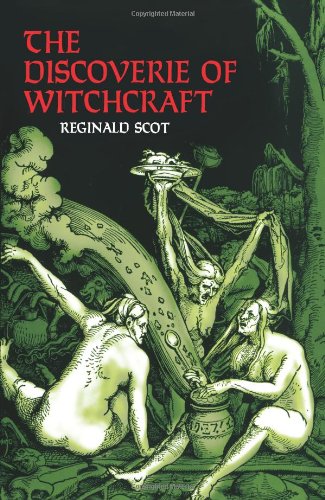
This month being our first foray into this article, I thought it most appropriate to start with what many consider to be a foundational book, among one of the first comprehensive books written on conjuring, The Discoverie of Witchcraft by Reginald Scot.
The Discoverie of Witchcraft was written in 1584 and is considered to be the first practical treatise on conjuring written in the English language. Its purpose was not to serve as a text of magical secrets, rather it was somewhat akin to Houdini and his debunking of psychics and exposing their trickery secrets – it was meant to serve as a skeptical look into the practices of magic and supposed witchcraft, or, black magic, to counter the witch hunting craze during the Inquisition and ridicule the “standard” texts on the subject and their implications. The Discoverie of Witchcraft was a book, according to Scot, “wherein the Lewde dealing of Witches and Witchmongers is notablie detected, in sixteen books … whereunto is added a Treatise upon the Nature and Substance of Spirits and Devils, 1584.”
Reginald Scot believed that it was irrational and un-Christian to accuse people of practicing witchcraft and to prosecute them of such. He believed, and held firmly in the belief, that the Roman Church was responsible for this unjust way of thinking. It was a popular belief for many years that all copies of this manuscript were burned upon the accession of James I, the son of Mary, Queen of Scots.
Scot had done research and gathered his information from studying the works of various authors, which he numbered over 200, the superstitions of witchcraft, especially in the legal courts where the prosecution of witches saw no end, as well as in villages where it was all but too easy to accuse another person of witchcraft as the belief of black magic and its progenitors came from every imaginable thing. If your cow died of old age, surely, it was not old age but was rather the cause of it having been touched by a witch…
The people in a village who tended to be accused, tried, prosecuted and executed as witches were those who were poor, elder, less-social and newcomers to a village. Scot was attempting to prove that witchcraft was rejected by logic and religion, that any sort of manifestation was nothing more than the result of a person willing themselves to believe it and that the resulting illusions, perceived as works of a witch or warlock, were figments of a strong or overactive imagination. By disproving the common belief, Scot was hoping to spare innocent lives of those accused of witchcraft.
The author himself was indeed superstitious, at least in a contemporary sense. He believed that unicorns held medicinal value; he believed that the existence of precious stones was directly influenced by heavenly bodies and that to a certain degree that the Devil had the ability to absorb souls. These were related in the book as references to medicine and astrology. He also wrote stories in the book about magicians with supernatural powers performing for various courts of royalty.
This tome became the reference for all things concerning and related to witchcraft, spirits, spirituality, alchemy, magic, legerdemain and of course, skepticism, especially his, and especially as related to witchcraft. It was such an influential text that William Shakespeare studied this book and used it to draw specifics when created the witches in his play, Macbeth, and Thomas Middleton used it in the same way for his play called The Witch. The sections detailing the accomplishment of “magic tricks” served as a basis for later and equally influential books, The Art of Juggling written by S. R. in 1612 and of course, Hocus Pocus Junior, written in 1634, whose author is still unknown today. The early writings of Scot constituted the majority (in some cases, nearly all) of the text that existed in the English language on the subject of conjuring in the 17th and 18th century.
Of course, this book did not come without its detractors and those who sought to discredit Scot and his work. Among the many who spoke out against him were George Gifford (in his works of 1587 and 1593), Gabriel Harvey in the 1593 book Pierce’s Supererogation, Henry Holland in his Treatise of Witchcraft from 1590, James VI of Scotland in his 1597 book, Dæmonologie in which he labeled the opinions of Reginald Scot and one of his greatest influences, Johann Weyer (the author of De Præstigiis Demonum, 1566), as “damnable”. There were many others, but one that was probably more well-known than others was Thomas Ady, author of Candle in the Dark: Or, A Treatise Concerning the Nature of Witches & Witchcraft, which was written in 1656.
Now to the part which I am sure some of you were eagerly awaiting, at which you may be somewhat disappointed, or perhaps (hopefully), fascinated: the chosen effect from this book.
It may surprise many readers to read how many of our rather “standard” magic effects, or at least some of their origins, appeared in The Discoverie of Witchcraft. The effect that I am going to detail here might sound familiar to many of you. It comes from Chapter XXXII (32): To burne a thred, and to make it whole again with the ashes thereof. Sounds a bit like the modern ‘Gypsy Thread’, and indeed it is. In short, and transliterated for your ease of interpretation, the secret is thus:
- Take two threads or small laces, each one foot in length, roll one of them into a ball about the size of a pea; hide it between your left forefinger and thumb.
- Take the other thread and hold it in front of you between the thumb and forefinger of each hand, holding all other fingers openly, relaxed.
- Have a person cut, with a knife, the thread in the middle.
- Place the ends together, re-grip between the thumbs and forefingers as before and being sure to keep the whole thread hidden, and repeat.
- Once or twice more, this is repeated until the pieces are very small in length, and then roll all of the loose pieces together the same as the whole thread, using your right fingers.
- The left hand takes the knife and rests the rolled-up cut pieces on the tip and thrusts it into the flame of a candle until the threads are burnt to ashes.
- Pull the knife out and dump the cooled ashes into the left thumb and forefinger, and after you rub the ashes for a while, use the right thumb and forefinger to draw out the hidden thread to show it restored.
I think that this effect has stood the test of time, though it has undergone many presentational and methodical transformations, because it is inherently simple and straightforward. It is also easy to do. Whether you use this particular handling or a more modern approach, using it to tell a story about the loss of a great love or the triumph over personal trials and tribulations, this sort of thing connects your audiences with one another and with you. That connection happens on a rather deeper level and will affect each person in a different way, all of which are very powerful. I urge you to explore the ‘Gypsy Thread’ effect for this very reason, if you do not already perform it yourself.
To get you started, here are a few resources of some excellent versions [Ed Note: Consult our local Brick and Mortar Magic Shops to find these references]:
- The World’s Greatest Magic DVD library: Gypsy Thread
- The Dragon Thread DVD by Mike Wong
- The Eternal String by Max Londono
- The Gypsy Balloon by Tony Clark.
If you have not read this book, I would highly recommend it because it is rather enlightening with regards to the history of the art of magic – not only the for the methods but the thinking that was ultimately behind (read: responsible for) them.
The book is written in Early Modern English (EMnE) and may be indecipherable to some readers without knowledge of that period language, or even a working knowledge of Middle English. If you do tackle the book and need help transliterating it, please let me know and I would be more than happy to help!
I hope you have enjoyed this first article and found it to be of value, whether to the satisfaction of your own fascination with magical history or, perhaps, to tell you about the existence of potentially interesting and informational books on our humble art form, which you may have been unaware of.
 Happy reading folks and I will see you next month!
Joaquin Ayala, PhD.
Club Librarian