

Ex Libris
By Dr. Joaquin M. Ayala, PhD
Max Malini: King of Magicians – Magician of Kings by Steve Cohen
Hello folks and welcome to the Ex Libris article for April 2026! I know I bid you all a good incoming Spring season last month, and for most of you, that has been mostly the case. As for me, we received a massive dump of snow from an historic blizzard on March 16th and 17th, which completely our car and half of our house. Thankfully, no damage occurred, but the icy conditions did remind me of something, which brought me to the book for this month.
Most of you will have heard a lot about the magician named Max Malini. He was famous for many things and quite a few quotes, but how much do we really know about the man behind his own legend? Max Malini: King of Magicians – Magician of Kings by Steve Cohen is a 521-page 8 x 10 format hardcover book, originally published in 2021 by Squash Publishing in Chicago, IL.
Many readers will know the author Steve Cohen, whose Off-Broadway show, Chamber Magic, is one of the longest-running, highly successful formal parlour shows in the history of the art. He is famous for his Any Drink Called For with the magic tea kettle, and of course, his expertise on Max Malini. He has also authored articles and small booklets for the magic community as well.
This book is genuinely luxurious, everything from the blue gilt book cloth and the textured end papers to the period-style Smyth-bound glossy archival paper. This book even weighs in at an impressive FIVE pounds! Cohen begins the book by covering the early life and the beginning of Malini himself, addressing some of the things that people already know or have heard about, and correcting some minor inaccuracies about that knowledge. There are some funny Yinglish quotes in there, to boot!
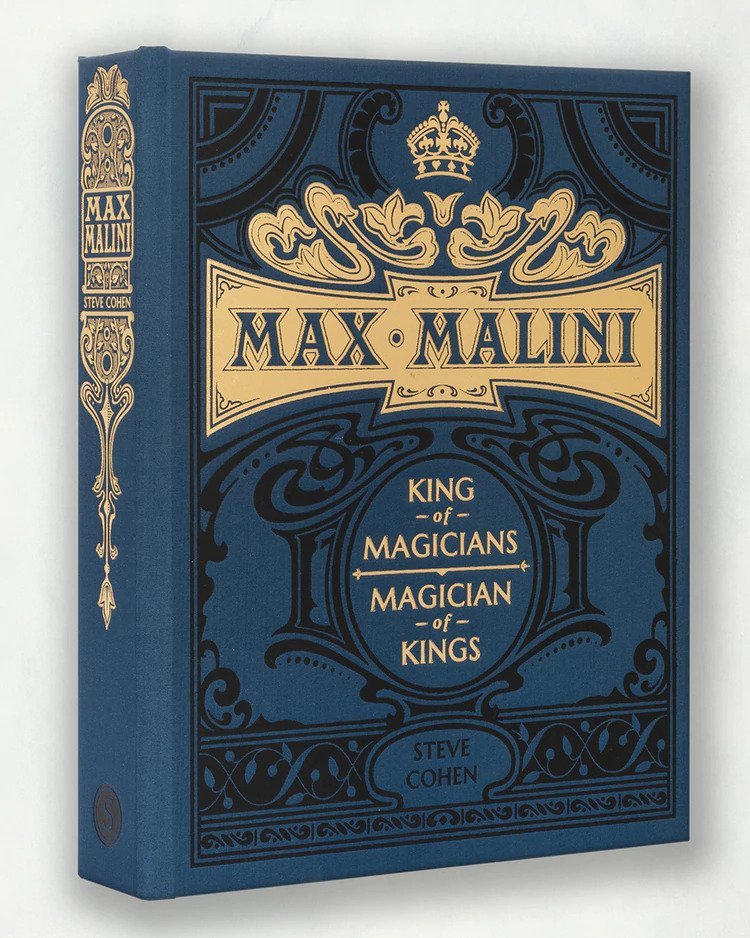
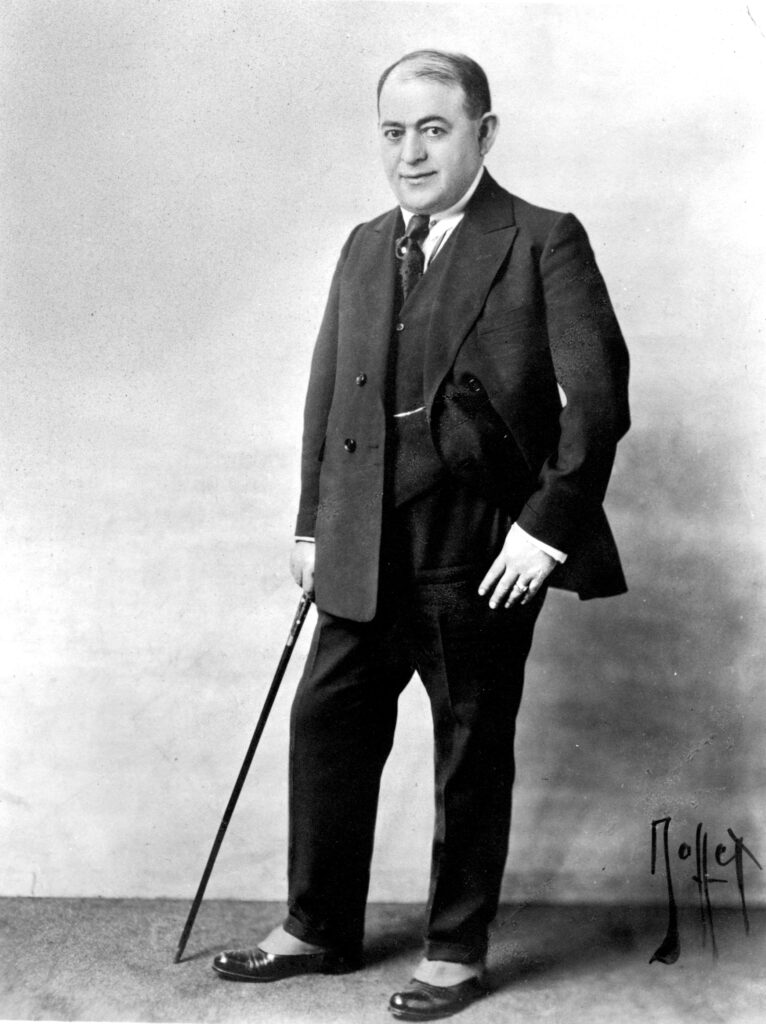
The first eight chapters cover a myriad of topics, from biographical information on Malini and his family, his business practices, his reputation (he was truly a well-respected man and magician), his travels and exploitations, along with lots of photos (both colour and B&W), illustrations and poster reproductions. There are even a few magical techniques and one-off effects thrown in here and there for good measure. I thoroughly enjoyed this portion of the book because it was very well-written and covered a lot about an iconic magician, giving you insights to his charisma and character that were interesting, both on a professional and personal level.
The rest of the book is dedicated to his body of work across five further chapters (fourteen total), including impromptu magic and techniques such as palming, vesting, ditching of objects, etc. Some of the effects detailed in the impromptu section will be familiar to those of you who have read various beginner magic books, effects like Ring on Stick, coin vanishing/manipulation, impromptu Cups & Balls, Cut & Restored String, Obedient Matchboxes, and the Vanishing Glass Under Newspaper (which often performed with a coin and a saltshaker). These handlings, however, contain the Malini Touch. Among my favourites here include his equally famous Button Biting – wherein you bite the button off the jacket of an unsuspecting person and then restore it. The method(s) are varied, and not truly impromptu, but stellar if you can pull it off, and they are just oh, so Malini!
Among the effects in this chapter is the Brick from Hat, which leads right into the legendary “holy grail” effect for which Malini is best known: his production of a big block of ice from under his hat. Just think of the impossibility, given all that you know about ice, time, and whatnot…This is covered in great detail, including how anything can so easily become so legendary.
Chapter ten covers card magic, including several standard card sleights adapted by Malini. The effects themselves are all good, but they are nothing terribly uncommon among studied card workers. They include things like the General Card (one of my favourite effects, also related to Everywhere and Nowhere and The Universal Card), Card to Mouth, Card on Ceiling/Wall, Rising Cards and even a multiple-selection routine.
One killer bit that is hidden among these is under the subtitle of Gutter Magic. It details the story about Malini planting a worn and beat-up card for something that could potentially happen later, but which also may never come to fruition. Absolutely brilliant and very, very powerful. Side note: If you have seen the At the Table LIVE lecture by Nicholas Einhorn, you may remember that this idea was used in conjunction with a Rainbow Deck routine, which, in my opinion, is one of the strongest things ever. If you have not seen this lecture, you can find it through your favourite dealer as a DVD or a download. VERY HIGHLY recommended!
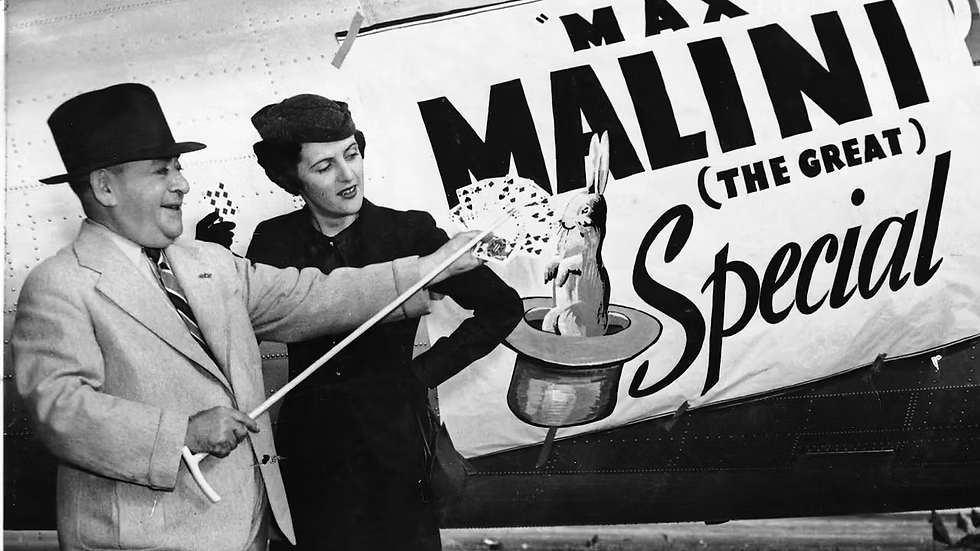
Chapter Eleven covers Platform Magic, things like Color-Changing Silks, Cut & Restored Rope (which includes some work by Detroit-native magician Bob Stencel), Button Biting (again, with different methodology), Chinese Linking Rings, Chinese Water Bowl Production and two more legendary (there’s that word again) effects, the Malini Egg Bag and the Blindfold Card Stab, the latter two being effects most associated with Malini outside the ice block production, in my opinion. Both effects receive a veritable workshop’s worth of space in this book, and rightly so.
The Blindfold Card Stab and the Malini Egg Bag were effects also associated with another megastar of magic, the venerable Johnny Thompson, who certainly popularized both with a modern audience, alongside magician Bob Sheets, who gives his insightful thoughts to the Card Stab herein.
Chapters Twelve, Thirteen and Fourteen cover a bit more about Malini and his magical philosophy, as well as his obituary in Yiddish and Japanese. The rest of the almost-100 pages covers the appendices I-III and the acknowledgements for this book. In 2026 a second edition was printed and released; the second printing includes minor corrections, updates, and additions, as well as a new binding color, but is not substantially different in content from the first edition. It is also exactly the same in terms of its luxurious features.
Until next month (May?!?!), keep the magic alive and enjoy whatever weather you have – we may be snow-free by July up here!
-jma