

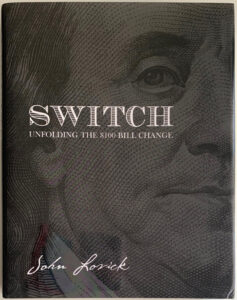
SWITCH: Unfolding the $100 Bill Change by John Lovick
A book review by Dr. Joaquin M. Ayala, PhD
Hello folks and welcome to the Ex Libris article for January 2026 – Happy New Year to all! It sounds strange to be saying that, but I do hope that everyone had a fun, safe and magical ChristmaHannuKwanzikas!
As always in January, I try to pick a book that will take us “back to basics,” be it in concept, subject or just all-around beginner-esque in its quality. Many magicians are familiar with the old stand-by of magic in the effect that is ‘The $100 Bill Switch’, and since it is considered a basic effect, albeit an extraordinarily strong one when presented well, I think the book for this month is quite appropriate. We will delve into “SWITCH: Unfolding the $100 Bill Change” by John Lovick. This is a 346-page hardcover book originally published in 2006 by Murphy’s Magic Supplies, Inc.
[EDITOR's NOTE: Per Josh, this book is in stock and available at Wunderground Magic for $50. Stop by or give them a call at (248) 280-5925]
 If for some reason you have been living under a rock and are unfamiliar with the basic effect, the idea is simple: A blank piece of paper or a piece of newsprint, sized similar to a banknote, is folded up into a small packet, and upon being unfolded again, it has changed into a $100 bill! Another version of this is a different effect that most magicians are familiar with, but shares the method, and that is the “Inside-Out Bill” or “Mis-made Bill” where a $1 bill is turned “inside-out” with the four outside corners of the bill moving to the center part of the banknote.
It is a stunning piece of magic, simple though it seems. There have seemingly been as many versions and methods as there are grains of sand on a beach. This book contains many ideas, some of them using a thumb tip and others using nothing but the two pieces of paper. The book begins with a section on the history of the Bill Change, followed by fourteen pages of philosophical and practical questions and solutions to the ‘what and why’ parts of the effect. This is followed by a short treatise on the origins, uses and techniques of/with a thumb tip, and a hot tip (see what I did there?) - some of this information is readily applied to other effects with this gaff.
The meat of the book begins with the original as first reportedly seen in 1975, the creation of Vladimir Vladimirov (Владимир Владимиров), known as “Vlado”. Two standard variations follow from Mike Kozlowski and Roger Klause, the former of which really made some waves with his handling back in the late 1990s, mostly due to its clean handling and deceptive appearance. Since then, many other notable magicians have become known for their work on this plot, such as Jay Sankey, Gregory Wilson, and Michael Ammar.
I would be remiss not to mention some of what I consider a few stand-out effects in this book. One of the personal favourites includes Around the World in 80 Dollars by David Acer, as well as Foreign Affair by the aforementioned Gregory Wilson. Both effects are ones that I have used for years, and both feature a borrowed bill that changes multiple times. There are lots of great presentation possibilities with these two!
There is a stunning Bill to Pen effect that I have used extensively in the past, which uses the methods of the $100 Bill Change, but is only possible with Euro banknotes. If you ever find yourself travelling to Europe and planning to perform magic for anyone, let *this* be the thing you study and practice for – trust me, well worth it! In short: The magician borrows a Euro note and hands the participant a pen with which to write down the serial number. The note disappears in a flash, and later reappears in the very pen used to write down the serial number…and which NEVER leaves the hand from the time BEFORE the note vanishes!
Three of my favourite uses for the technique using the Mis-made Bill effect are included here, notably (I did it again!) Picasso’s Bill by Marc DeSouza, where you draw a stick figure on a borrowed note and then transfigure both the bill and the stick figure, before restoring it, signing it, and handing it out as a souvenir. The other two are identical in effect and method, but still different, and those are Autograph Collection by Andrew J. Pinard and Signature Piece by Gregory Wilson (this name just keeps popping up, eh?). In both cases, a signature/autograph, and in the latter case, date/time/etc. written on the borrowed bill transfigure into the mis-made note and back again. These three effects are different overall from the standard effect, and the nuances serve to make it even stronger still. Just imagine if you possessed a $1 bill signed by your favourite magician/celebrity, and then you transform it right in front of the eyes of your audience, twice…Now imagine, if you will, being able to do the exact same thing with the signature of your audience participant and a borrowed note… …*THAT* is NOT included in this book, but it will be discussed in the February 2026 article!
This book also includes some other fun and clever uses for the technique to affect the effect, as it were. You will find discussion on bill origami (and some of you will be familiar with the Dr. Robert “Bob” Neale Bunny Bill, which can be used to significant effect with a change, as well as borrowing a $1 bill and changing it into an origami ring, etc. There are hundreds of origami figures in existence which would work very well with the bill switch techniques herein.
There is even a section with additional ideas that use the technique for a different effect altogether – changing an aspect of the paper or note as opposed to the paper/note itself, if that makes sense. For example: Jay Sankey describes Unholy, using a page torn from a small spiral notepad. At the end, when the page is unfolded, the holes along the edge are no longer torn. Another favourite of mine from Jay is his Travelling Expenses, which is a Hole Matrix effect using a banknote.
One of the features I liked in this tome is that each effect opens with a short bio of its creator (where applicable), the effect description, the necessary implements and whether it is a thumb tip or ‘tipless’ switch. It covers even more with some bill vanishes, productions and non-banknote effects using the aforementioned techniques. In reading this book, I would strongly suggest you do as Jamy Ian Swiss did in his foreword: read this book in order, rather than skipping around; this will prevent the “flipbook” effect of seeing hundreds of (seemingly or not) similar drawings (many by the King of Magic Book illustration himself, Tony Dunn) over and over.
Well, that wraps up the article for this month – if you have ever had and interest in the $100 Bill Switch, PLEASE check this book out as it contains a veritable lifetimes’ worth of information and, dare I say, technology, as to the effect. Take care and I look forward to “seeing you” next month!
Yours in the Secret Art,
J.M.A.