

Dunninger’s Complete Encyclopedia of Magic by Joseph Dunninger
A book review by Dr. Joaquin M. Ayala, PhD
Hello folks and welcome to the Ex Libris article for December 2025! December?! Wow! We say it every year, but this year really did seem to fly by, so I thought I would talk about a book which is in the physical club library, and which some of you may have already read/seen in the past.
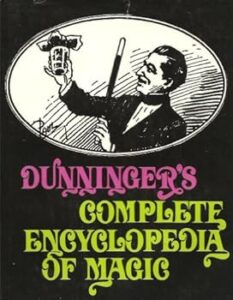
Dunninger’s Complete Encyclopedia of Magic by Joseph Dunninger is a 288-page, 9” x 11” hardcover book first published as a combined single tome in 1967 by Lyle Stuart, Inc. Later editions were printed in 1970 by Spring Books and again in 1988 by Bonanza Books.
This is a decidedly different kind of magic book because there really is a blend of this & that, some old science-based “entertainments,” old parlour stunts and chemistry-based marvels, puzzles, there is a little parlour magic, some close-up, mentalism, stage and yes, even illusions included here. Some of what is described is questionable, questionable as to whether you would be able to pull them over on a modern audience.
 The way this book is written and illustrated, the text is a little smaller and the layout is quite different from a traditionally constructed magic book, so it will force most readers to slow down and take their time reading it. In fact, this is one of those books where you would be better suited to picking out a random page or effect from the table of contents, and reading that, and bouncing around a little as your fancy or your random choices dictate.
The variety in this book is another aspect of its unusual nature in that there are plenty of effects that require no gimmicks, some that do and others that require spending a good deal of time, and possibly, money to get everything together (the aforementioned stage illusions), yet a few are nearly prop-less, and still others requiring things you may or may not already possess.
This same variety also speaks to the level of skill required to execute the things in this tome, should you wish to use the variety. There are no really knuckle-busting things in here, but the more advanced skill sets required would be things like audience management, staging, rigging, etc. There is plenty in here for magicians of all skill levels.
A few examples of things contained herein: There are three unique uses for an old inkwell or bottle to accomplish simple mental telepathy, and it is not what you might think. Very clever! There is a device that you can make to which you may impossibly link and unlink borrowed keys, rings, and similar objects. This device, given modern props that are available, may be slightly obsolete, but it is still a genius contraption because it can also be examined before, during and after the effect.
When I was younger, I particularly like the method for the Watch in Balloon because it used a simple bit of prop, and I ended up over-engineering that same method to incorporate a borrowed watch, a “cannon” and a Tommy Wonder-esque way of getting the watch “inside” the balloon for the reveal. It was one of those old-timey feeling parlour effects that I loved so well!
There is a method of moving or even slightly levitating a table on-stage using an arcane method, but it is not a solo effect – it requires a bit of thought and a hidden assistant, but it could be incorporated into spiritualism effects, perhaps a mental effect, or perhaps played as a gag throughout the show.
You will also find a fun way to make ghosts appear on-stage, and no, this is not a “cheesy/har-har” method either; you can really take this and run with it to make it more elaborate, right along with a method for the old Rapping Hand, which is usually employed in spirit Q&A types of routines where it taps a different number of times to answer “YES” or “NO.”
If you enjoy visual and mind-bending illusions, there are pages dedicated to describing why we perceive them in the ways in which we do, and you can even use those ideas to create your own. There are plenty of standard and not-so-standard card effects like Static/Magnetic Cards, methods for Rising Cards and productions and vanishes of cards. There are effects and bits using coins, paper money, crayons and coloured pencils and much, much more.
I do hope you will dive into this book and explore it because as I previously stated, it certainly has plenty of “stuff” for everyone and all skill levels, even things that require no dexterity at all. Word has it that it was also one of the first books that our current Secretary read and is a favourite of his, and with good reason!
Well, that is all for this time folks – I wish for all of you a fun, safe, joyous, and Happy ChristmaHannuKwanzikas, and a healthy, prosperous New Year in 2026!
Happy Holidays to all of you, and we will “see” you in the new year! Keep the magic alive.
JMA
Editor's Note: As Joaquin mentioned, this was one of my first magic books. It is a great book to leave out on your bedside table, coffee table and in the days before cell phones, in your bathroom…. :-). It is a great book to pick up, open to a page and browse for a few minutes. No need to read cover-to-cover in one sitting and probably every time you open it you will find something new. -Karl