

Theseus – A Magical Journey by Nathan Colwell
A book review by Dr. Joaquin M. Ayala, PhD
Hello folks and welcome to the Ex Libris article for February 2026! This year is certainly chugging along and I hope the article last month inspired you to delve into the effect of the Bill Change – I will implore you to do so if not because it is such a strong piece that you can carry on your person at all times, and for that matter, you can even carry more than one version without taking up hardly any space at all.
the article last month whilst discussing a trio of effects using drawings/signatures on the banknotes, I mentioned that two of the effects could be done with a borrowed note that was signed by the spectator, as opposed to you. There is more work involved for that to happen, but it is a sneaky, devilish and very powerful tool to possess. That is where we look to the book for this article: ‘Theseus – A Magical Journey’ by Nathan Colwell*. This is a 108-page, small format hardcover book, originally published in 2021 by Magic, Inc. in Chicago.
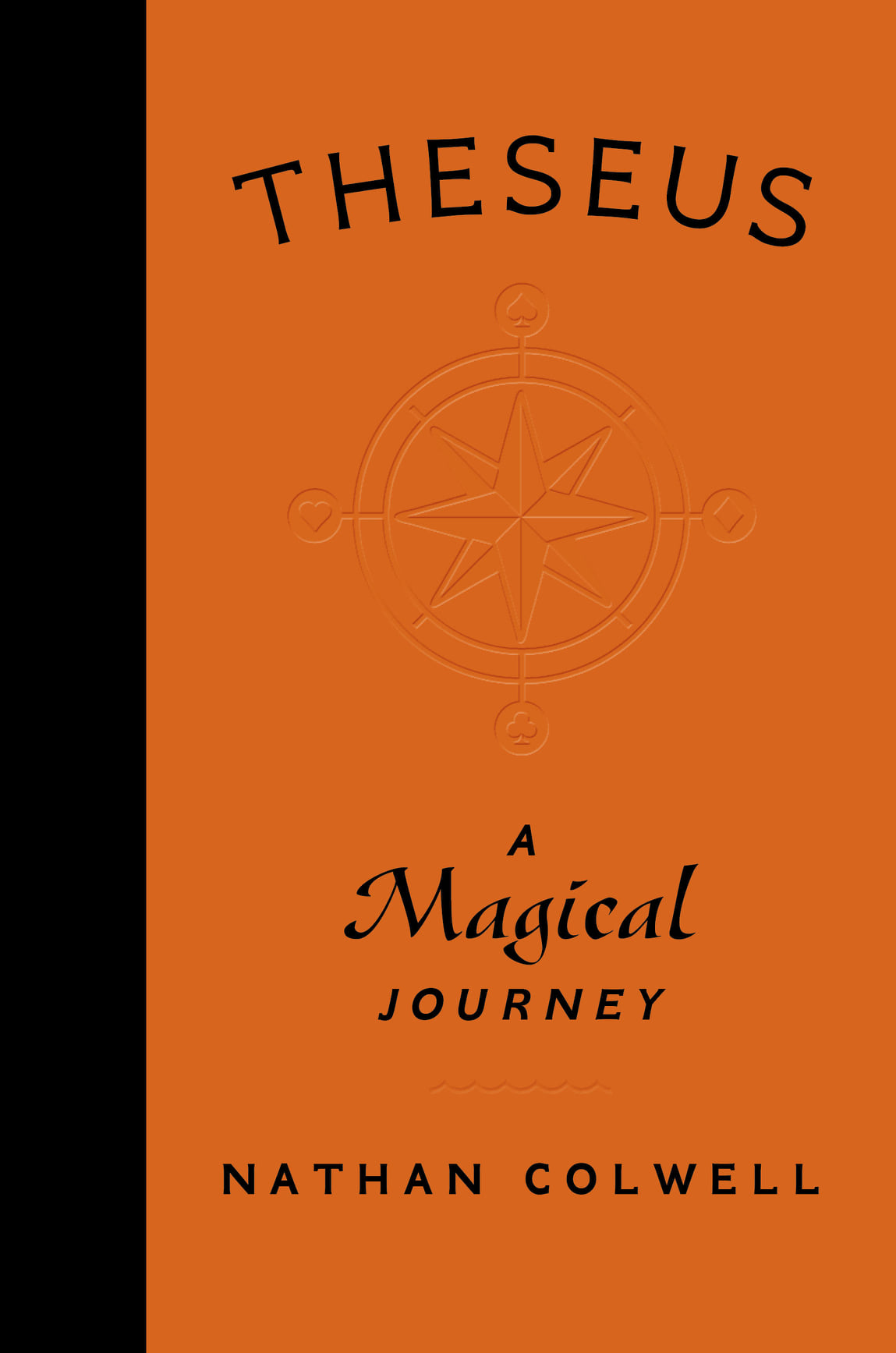 Now this book is all about one effect and its various handlings and methods. It is a card plot, and a very intriguing one at that! Some of you readers will be familiar with the classic thought problem called The Ship of Theseus. If not, to sum it up: The thirty-oared ship of Theseus was preserved for a long time, but over time as pieces started to rot away, the curators would replace them with new and identical pieces until, eventually, every piece of the ship was replaced, and no original pieces of the ship existed. The puzzle: With every piece of the ship having been replaced, is it still the Ship of Theseus?
As an example of this plot, you have an audience member select and sign a blue-backed card in such a way that the writing touches all four quarters of the card. You then rip it into quarters, placing them face-down on the table. One by one, you replace the torn pieces with pieces of a quartered red-backed card. Upon turning the pieces face up, the signature of the spectator is still on the front of the pieces! Just think of how impossible this sounds as you read it, then think about how impossible it is from the view of the layperson…
In Part I: The Logbook, the author describes the plot, the history behind it and the philosophical parts of both the effect itself and of each of the methods. There was a total of 10 solutions (read: methods) developed, four of them appear in Part II: Open Sea. The numbers of these solutions, Nos. 3, 5, 6 and 10 are the order in which the author devised them; these are the ones the author felt were, “…fit for public consumption…” The missing solutions are discussed throughout, but details as methods are not given.
In Part III: Adrift, Solution Nos. 7 and 8 are given because they were deemed necessary for the sake of complete explanations of the plot and help to give the full context of the thinking behind the concept. In this same section, the very first prototype of the plot is explained, again to help provide the full backstory, but it is noted that the author considers it practically unperformable. In Part IV: Fellow Travelers, you will find two amazing solutions by none other than Harapan Ong and Simon Aronson, the latter of which my readers will very well be familiar with.
Fair warning: This book may read a little dry for some at first reading, and I think the author realized this would make it a bit more tedious to re-read the description as you attempt to follow each solution with props-in-hand. I could be wrong, but the part that I really appreciate here is that for each solution, across the board, what follows is the Fundamentals section; in this section the steps of the actions and the method are laid out in summary form, with numbered steps for each of the four pieces. This makes it so very easy to follow along once you are familiar with each method.
NOW, remember when I referenced that sneaky, underhanded bit of something earlier? What follows is that something. In this book you will learn ways to obtain, openly and without sleight of hand, genuine duplicate signatures of a spectator. Imagine the insane things you can do outside of this effect if you can obtain duplicates of the same signature! These techniques are not inherently complicated. Of course, once you get the idea, you can even go for a sleight of hand method on the fly (think ‘swami gimmick’). Now apply this to the signature-based effects in the Mis-made Bill section of the Lovick book from the January article…
Well, that is all for this month! Join me again in March when we will be switching things up, (quite literally) just in time for the switch to Spring! Until then, keep the magic alive!
- J. M. A.
*Nathan Colwell is the name you will use and find when searching for this book; Nathan is now known by the name Nancy Colwell.